

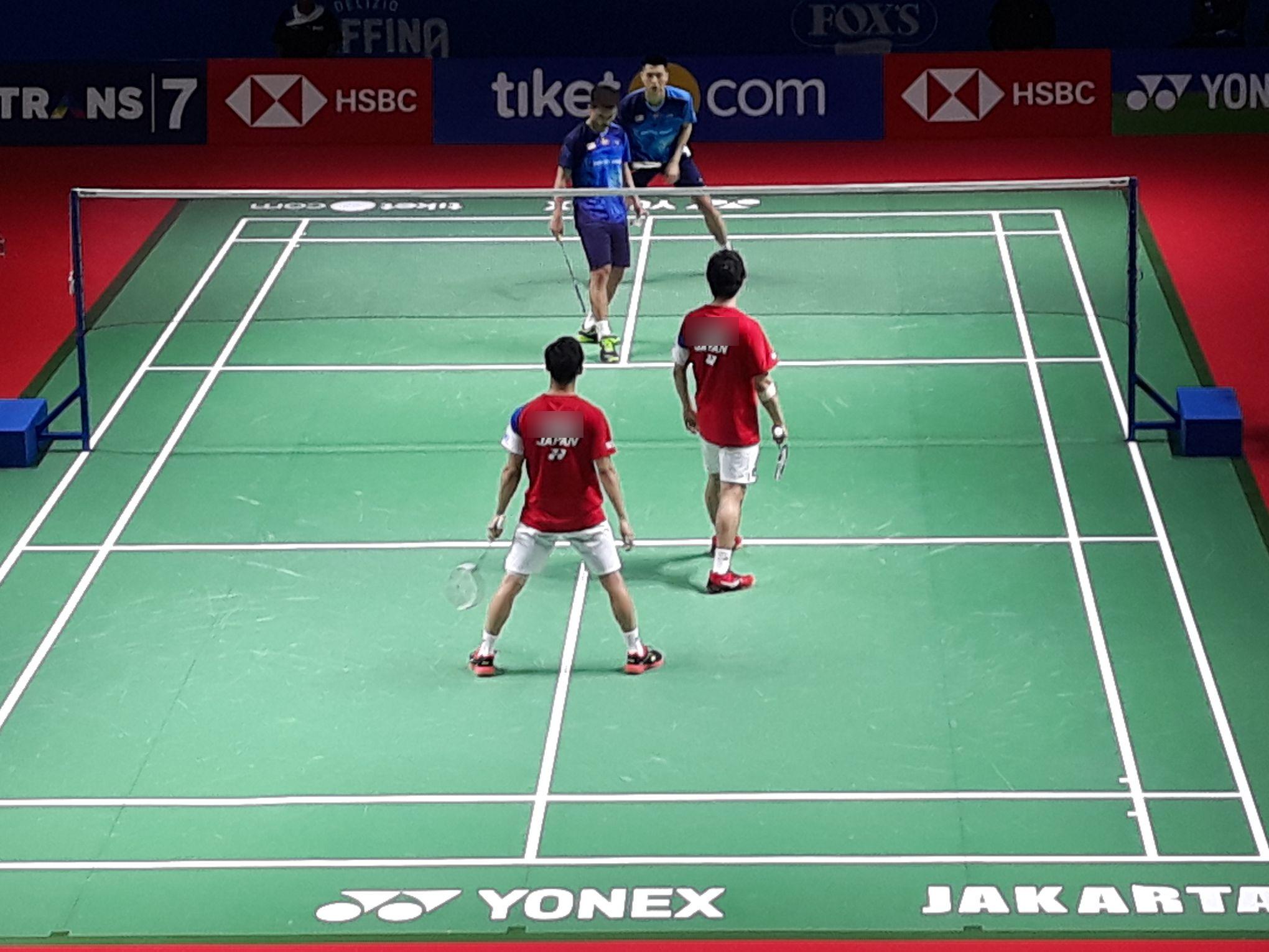
A doubles match at the Indonesia Open, 2019. Not our client. Photo: Griff88, Wikimedia Commons, Creative Commons Attribution-ShareAlike 4.0, cropped and edited.
In October 2026, U.S. Citizenship and Immigration Services (USCIS) approved a P-1A petition we filed for a professional badminton player. The P-1A is the U.S. work visa for an internationally recognized athlete. The U.S. badminton club hiring her had first been told by other lawyers that the case could not be approved. USCIS approved the petition for five years, 15 business days after we filed it, without first asking for more evidence. So the club does not have to file again each season.
We have left out the player's name, her home country, the club's name and any detail that would identify either of them.
The client
She is a professional player who has represented her country since her junior years, with international medals and titles and a career-high world ranking she reached earlier on. A U.S. badminton club wanted to employ her to compete for the club in U.S. tournaments and to train, not coach, at its facilities.
The challenge
Her best international results, including her highest world ranking, were at least five years old when we filed. She had kept competing in recent seasons, but without matching those results, and other lawyers took that drop-off to mean the case could not be approved.
A P-1A athlete must be internationally recognized. The regulation defines that as achievement that is "renowned, leading, or well-known in more than one country" (8 CFR 214.2(p)(3)). The athlete must also be coming to compete in events that require internationally recognized athletes (8 CFR 214.2(p)(4)(ii)(A)). The risk in a case like hers is that USCIS treats a few seasons of weaker results as a sign she is no longer internationally recognized.
What we did
We treated her career as one record, not a list of old results, and showed that she was still competing at the international level the U.S. tournaments on her schedule require.
- More evidence than the minimum. The regulation asks for at least two of seven kinds of evidence (8 CFR 214.2(p)(4)(ii)(B)); our P-1 visa page for athletes lists all seven. We documented five of the seven, not two, so the case did not rest on any one kind of evidence. The two we did not use, a season in a major U.S. sports league and a season of U.S. college competition, did not apply to her. The five were: statements from the governing bodies of the sport, a significant honor, international competition with a national team, an international ranking, and statements from recognized experts.
- The governing bodies, in writing. USA Badminton, the national governing body for the sport in the United States, reviewed her record and wrote a letter supporting the petition. Her home country's national badminton federation certified her medals, her national-team selections and her national ranking from its own records, so USCIS saw her record confirmed by her federation, not only claimed by her.
- Her peers, in writing. Two players ranked in the world's top 25 in doubles when we filed, former international players and her coaches each wrote about her level of play, so USCIS heard how players at the top of the sport rate her today. A former national No. 1 player explained where her career-high world ranking placed her among all ranked players internationally.
- The U.S. events. Her schedule had six U.S. tournaments, including a stop on the Badminton World Federation (BWF) World Tour, the sport's main international professional circuit, which showed USCIS she was coming to play at the level the P-1A requires. USCIS looks at, among other things, "the extent of past participation by internationally recognized athletes" (USCIS Policy Manual, Volume 2, Part N, Chapter 2). For five of them we documented the prize money and the players who had entered in past years, to show that each one draws internationally recognized players. For the sixth, a new event with no past entries to show, we filed the BWF's official approval, which shows the sport's world governing body sanctioned it.
- The contract. The regulation requires a contract where contracts are normal in the sport, so we filed her five-year contract with the club, showing a real job at the level of an internationally recognized player.
- The consultation letter. A P-1 petition normally needs a letter from a labor organization (a union or similar body for the sport). Badminton has none in the United States, so we asked USA Badminton to confirm in writing that it knows of none, as our badminton page describes.
The outcome
The club paid for premium processing, a USCIS service that, for an extra fee, commits USCIS to act on the club's petition (Form I-129) within 15 business days, for example by approving it, denying it or asking for more evidence (USCIS, How Do I Request Premium Processing?). USCIS approved the petition within that window and without a Request for Evidence, the written request for more documents that would have added another round before a decision. The approval runs for five years, the longest an individual athlete's P-1A petition can be approved for (8 CFR 214.2(p)(8)(iii)(A)). The approval is for the club's petition, not the visa itself: she can now apply for her P-1A visa at a U.S. consulate and, once she enters the United States on it, compete for the club.
What this case shows
A few seasons of weaker results did not, on their own, end this case. What we put in front of USCIS was the record as a whole: governing bodies and international players who placed her at the international level, a competition record that continued into recent seasons, and U.S. events that need players of that standing. For an athlete in the same position, we have written about how to show international recognition when recent results have dipped.
Every case is different, and this result does not guarantee a similar one. The strength of a P-1A depends on the athlete's whole record, the events on the schedule and the evidence available.
If you are a club thinking about hiring an international player, or a player whose best results are a few years behind you, schedule a consultation to talk it through.